Monday, 27 April 2015

Chance to Visit Lich St


This Wednesday we'll be down at the Cathedral Roundabout so if you are in town you can come and find out what we've been discovering and the history of the site. We'll be there 9:30-3:30 and for the next three day, followed by Wed-Sat the following two weeks. You'll be able to sign up for tours and be taken across so you can see Lich Street and the remains of the cellars which have been uncovered. Look out for us in the hi-viz vests!

We are in the process of getting access to a shop unit next to the site where we can show you historic photos and images as well as have some finds. We had hoped to have the keys for this and to have started site visits but we don't have access at the moment. If we have been unable to move in by Wednesday we'll run the first few days from near the Elgar statue. We'll have copies of photos with us to show you and begin the tours from there so you'll be able to find out more and ask any questions you have about the site and the archaeology.

Tours
You can sign up for a brief tour of the site whilst you are down there. Due to the restricted nature and having to cross the roundabout where there is no crossing these will be in small groups, and we'll ask you to wear a hi-viz vest. We'll then take you down Lich St so you can see the site from inside the railings. The tours will probably last around half an hour including setting the scene, and we'll run them as frequently as we can, so as many as possible can see. Please wear sensible footwear as the ground is uneven.


Friday, 24 April 2015

On the Tiles - again

These lovely pieces were found within some of the backfill we have been clearing. They look like the sort of tiling which would have graced the parlour of a pub, and there are a number of pubs which were situated very close by. However these have moved after demolition of wherever they had been standing so can't say which one. They seem quite distinctive so wonder if anyone can recognise these?


Thursday, 23 April 2015

Rose's memories of Lich St

We continue to get people contact us with their memories of Lich St. One of our community archaeologists, Justin, went out to interview a couple of people this week, so their information can go alongside the formal archaeological report which will be produced.

One person we spoke to was Rose Woodyatt, who lived at Court 2, house 4 Lich Street from the age of 3 in 1931 to the age of 22 in 1950. You may have heard her a couple of weeks ago on BBC Hereford & Worcester's breakfast programme, and they kindly put us in touch with her.

 
In the first two clips Rose describes the inside of her house.


In the third clip Rose describes the 'Lich Gate stone ledge' which, amongst other uses, supported coffins on their passage to College St and the church or Cathedral – it appears that there was a common custom that the bereaving family had to gain permission to move the coffin beyond the city (wall).


Tuesday, 21 April 2015

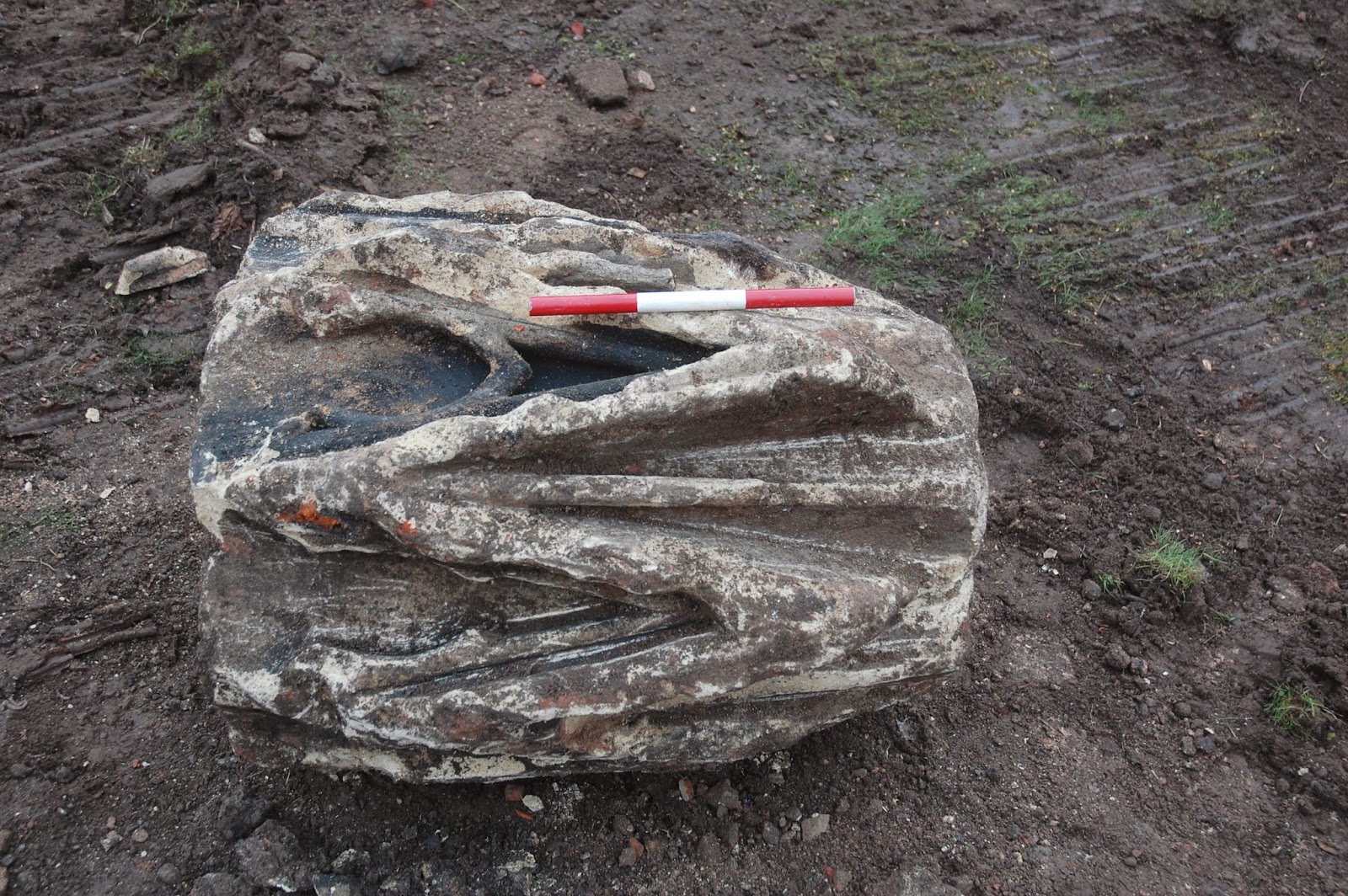
Masonry from St Michael's


This amazing bit of masonry was discovered on site in backfill. It is well made so we wondered where it would have come from. Then an eagle eyed archaeologist thought they had seen it before and went back to have a look at one of the photos used in the preparation for the dig, and realised that it came from St Michael's, or is suspiciously similar. However the spot where it was uncovered was on the other side of the Lich St and a little way up, and this masonry had been on the College St side, so it had obviously travelled, after the church was demolished.


St Michael's was just to the south east of the excavation area under the road. This is the second St Michael's, the first having stood next to the cathedral. The main body of the church, which fronted College Street, lies under the road so we don't expect to uncover the church itself, although we have come up against an adjoining cellar wall.

This church replaced the medieval St Michael's in the 1840s. We have a poster from 1839 which invited people to donate towards the rebuilding, which is said was necessary due to the dilapidated state of the present church. The closeness to the cathedral is because it served as parish church to the immediate area and was the cemetery chapel, but it was decided to relocate the site in order to provide a better view of the Cathedral. We also have some specifications for the workmen involved in building the new church, such as carpenters, smiths and plasterers.


It was always a small parish as it only served the immediate vicinity of the cathedral, with other churches serving the rest of the city centre. In fact the northern side of the street was part of St Helen's. The 1851 Religious census, which compiled attendance figures from all places of worship, gave the population of the parish as 564, much smaller than the other city parishes, and attendance was under 100 for morning and evening services, much smaller than St Helen's and other nearby churches. A comment in the census stated that there was no Sunday School as there were only five or six poor families in the parish. The Church closed and became the Diocesan Registry in 1910, and was later demolished with the rest of Lich St in the 1960s. Some of the memorials went to St Helen's on the High Street, now part of All Saints parish.

Like many churches, St Michael's would have played an important part in the lives of the residents of Lich Street, not just on Sundays, but baptisms, marriages, burials, poor law administration, communal activities and charitable giving. The accounts of the St Michael's Charity are also in the archives, and it is noticeable that one of the trustees was Mr Arthur O. Mainwaring, who was also a grocer at No.1 & 3 (later renumbered 5) Lich St.


Parish records for St Michael's can be accessed through Worcestershire Archive & Archaeology Service in The Hive.

Friday, 17 April 2015

Out on the Tiles

For today's Friday Find we're looking at the roofs of medieval Worcester. Our county is rightly renowned for the beautiful thatched cottages that can be found in our rural villages. A well-thatched roof is an attractive, cosy and efficient cover, and thatchers' skills are in high demand once again as people rediscover the benefits of this ancient and sustainable craft.
However, in the crowded city streets of medieval Worcester, thatched roofs were a problem. Fire was a constant threat, and in the 12th century alone Worcester is recorded as having been burnt to the ground in 1113, 1131, 1139 and again in 1189!
In response to this problem, from the 13th century onwards we know that ceramic roof tiles were being made in the city: a tiled roof is much less flammable than a thatched one!
Medieval 'pegged' roof tile
The tile fragment above, discovered on the cathedral roundabout dig, was made in Worcester sometime between the 13th and 15th centuries. The tapering square hole would have held a peg to hook the tile over the laths of the roof.
It seems that flaming roofs remained a problem, because in 1467 the city ordinances introduced compulsory tiling, stating that
'for the prevention of fire neither wooden chimneys nor thatched roofs shall be allowed thenceforward; by midsummer's day next coming, the wooden chimneys should be replaced by brick or stone, and the thatched roofs by tiles'
Tilemakers were also required to stamp their wares with a maker's mark, and were forbidden from forming a union or guild. This is likely to have been an attempt to enforce quality standards and free trade, as the city feared that the new regulations would lead to a sellers' market.
Post-1467 rooftile stamped with maker's mark
The tile above was found recently in St Johns, and bears a maker's stamp in the form of a cross with flared arms, indicating it was made after the 1467 regulations were introduced.
We've excavated several Worcester kilns producing both roof and decorated floor tiles at around this date. The pictures below show the structure of a kiln on the Tything. There's an article by Laura Griffin with more information on this kiln in this issue of the Worcestershire Recorder, pages 5-8.
Late medieval tile kiln, The Tything, Worcester

Late medieval tile kiln, The Tything, Worcester

Wednesday, 15 April 2015

Delving into the Archives

Alongside the digging, we've been delving into our archives searching for historic images and maps of Lich Street and the surrounding area, as well as hunting through census records and trade directories to find out more about the people who lived there.
We have thousands of archive records about the county's history, covering about 12 miles of shelving underneath The Hive. Luckily, they're indexed, which helps us to find them easily!
© Crown Copyright Images reproduced by courtesy of The National Archives, London, England. Reference: RG 13 / 2278
Among the documents we've been looking at this week is the 1901 census. Here's an extract from it, with the details of 28 year-old Chimney Sweep Arthur Abbott, his wife Emily and their 4 year-old son, also named Arthur. They're recorded as living at No. 12 Lich Street, which stood on the site of Knight Frank Estate Agents. Arthur Abbott is also recorded in the trade directories for the street: in 1908, he has business premises at No. 25, and the family also seem to have run a lodging house at No. 31
Lich Street in 1886, with numbers mentioned above. Copyright Worcester City Council

We have a photo taken in 1906, looking west towards the High Street from Lich Street. The Lich gate is visible about half way along the row on the left of the photograph. On the right, you can see Arthur Abbotts sign, advertising his services at No. 25 as a Chimney Sweep and Kitchen Range Cleaner!
Lich Street looking west towards the High Street, 1906. Photographer F H Horniblow
The photograph below was taken shortly before the 1960s redevelopment of the area, and shows the rear of the houses within Court No. 2, with the rear of No. 25 in the background at the left of the picture.
The rear yards of Court No. 2, 1961. Copyright RJ Collins
There are lots of stories like that of the Abbott family buried in the archives. We'll be exploring their history, and more like them as the project progresses, and we'd love you to share your stories!

Tours & Exhibition

The Dig Lich St tours and exhibition will begin on 29 April, so you can find out more about what has been uncovered, look at some of the artefacts, and go across to have at the site.

Thanks for being patient – we had to wait until the work on the roundabout was at a stage where we could safely take you over you'd be able to walk up Lich St and have a look for yourself what has been found.

The exhibition will bring together information from the site and some of the artefacts we've been sharing on twitter and the blog. We'll also have photos, maps and census of the site telling the wider story of the area.

If you have memories of living or visiting Lich St there'll be opportunity to share your stories with us. We can also arrange to interview you at other times, if you are happy to do so, but during these times whilst you're visiting we'd love to hear what you can remember.


More details about these will be available next week.