Showing posts with label Archaeology. Show all posts

Tuesday, 28 July 2015

Preserving the remains

If you've been past the site recently, you'll have seen that the engineers have filled in the area of the dig in preparation for the roadworks. Many people are surprised that the site is being filled in with concrete; in fact, although it may seem strange, it's the best way to protect the archaeology!
A special mix of low-density foam concrete is used, all of the archaeological structures and deposits are protected with impermeable sheeting and sensitive features are lined with protective foam boards. This is all to ensure that there's no damage caused by vibrations or compaction from the road surface and turning area above the site. When the area is redeveloped again in the future, the concrete can be easily removed to expose the archaeological remains beneath.
Our archaeologists record a fine cellar wall made from re-used stone and tile...

The walls are shielded with protective boards, then covered in sheeting before concrete is poured
There was lots of interest in the idea of a viewing area, leaving the remains exposed or visible beneath a glass panel. It's a great idea, and we're pleased that so many people have shown an interest. Although preserving exposed archaeological remains whilst ensuring they don't fall to pieces is costly and difficult, it is possible, and we always like to see imaginative ideas for presenting our city's history!
In this case, though, there was one major problem: the part of the site containing the walls, cellars and footings of old Lich Street will be underneath the road and turning area for buses/lorries. Without moving the road even closer to the cathedral (which would disturb more archaeological remains including part of the Cathedral cemetery), or bridging the area (which would raise the road surface and block the view of the cathedral), we can't avoid this. Sadly, it's just not safe or practical to have a viewing area or a void underneath the road itself.
However, everything has been safely preserved, and the dig has given us a fascinating glimpse into almost 2000 years of history in the heart of Worcester! It's not over yet, either: as the project continues, you'll see our archaeologists down there keeping a 'watching brief', recording and protecting any more archaeological remains exposed during the work.
If you didn't get a chance to come and see our exhibition at Tudor House Museum last week, some of the displays and photographs will be staying in the museum for a few more weeks.

Tuesday, 21 July 2015

Exhibition at Tudor House Museum

If you're interested in seeing and handling some of the finds, we'll be at Tudor House Museum on Friar Street, Worcester this Thursday 23rd July and Saturday 25th July, 10:00 - 16:00, as part of the annual nationwide Festival of Archaeology. As well as the finds, we'll have pictures from the dig and a collection of historic photographs and paintings of the area from our archives. Our specialists will be on hand to answer your questions. All ages welcome!
Bone spoon, Tudor glass and 400-year-old Dutch 'majolica' pottery from the dig

Friday, 10 July 2015

Once the digging is done

Now that we've finished excavating the site, what happens to all the things we've found? Our Supported Internship student, Claire, has been helping us to clean, record and photograph the finds from the dig:
Claire with finds from the Lich Street Dig
Hello, my name is Claire Tippins. I've been on the work placement for four months, from the Heart of Worcestershire College as part of my two year Supported Internship program; I will be giving you an insight in what the Archive and Archaeology service do once they've finished digging the site (because archaeology's not all about digging!) .
Site paperwork: hundreds of records all have to be checked and cross-referenced
Once the digging on the site is complete, all the artefacts go through processing where they are carefully cleaned to remove dirt, soil etc. They are dried, then marked with codes that identify the areas where they were found.
Small fragments of a medieval bowl (left) and cooking pot (right), carefully marked with site and context codes

Finds from the dig in our processing room
Then they are weighed, recorded and further inspected to identify their date and purpose.
Senior Finds Archaeologist Laura Griffin identifies and records the artefacts

Our palynologist Dr Suzi Richer inspecting pollen from soil samples
After inspection they will either show some of the artefacts in public events or they are wrapped up, or placed in a plastic bag and placed in a box.
The finds store, where the artefacts are kept cool and dry before they are transferred to the musem
If the artefacts are metal they are placed in a sealed plastic box with special (silica) gel that keeps them dry and helps prevent corrosion.
Another thing we do is a lot of research in trade directories, business records, wills, census records, images, books etc. We do this to know who was living there and what their occupation was, and we do come across some interesting information.
View of north side of Lich Street during demolition, looking east towards the junction with Friar Street

I enjoy all the work I do here, it's different every day and the staff are incredibly friendly and relaxed. They enjoy my company, I love working here!

...We didn't bribe her to say that, honest!

Tuesday, 21 April 2015

Masonry from St Michael's


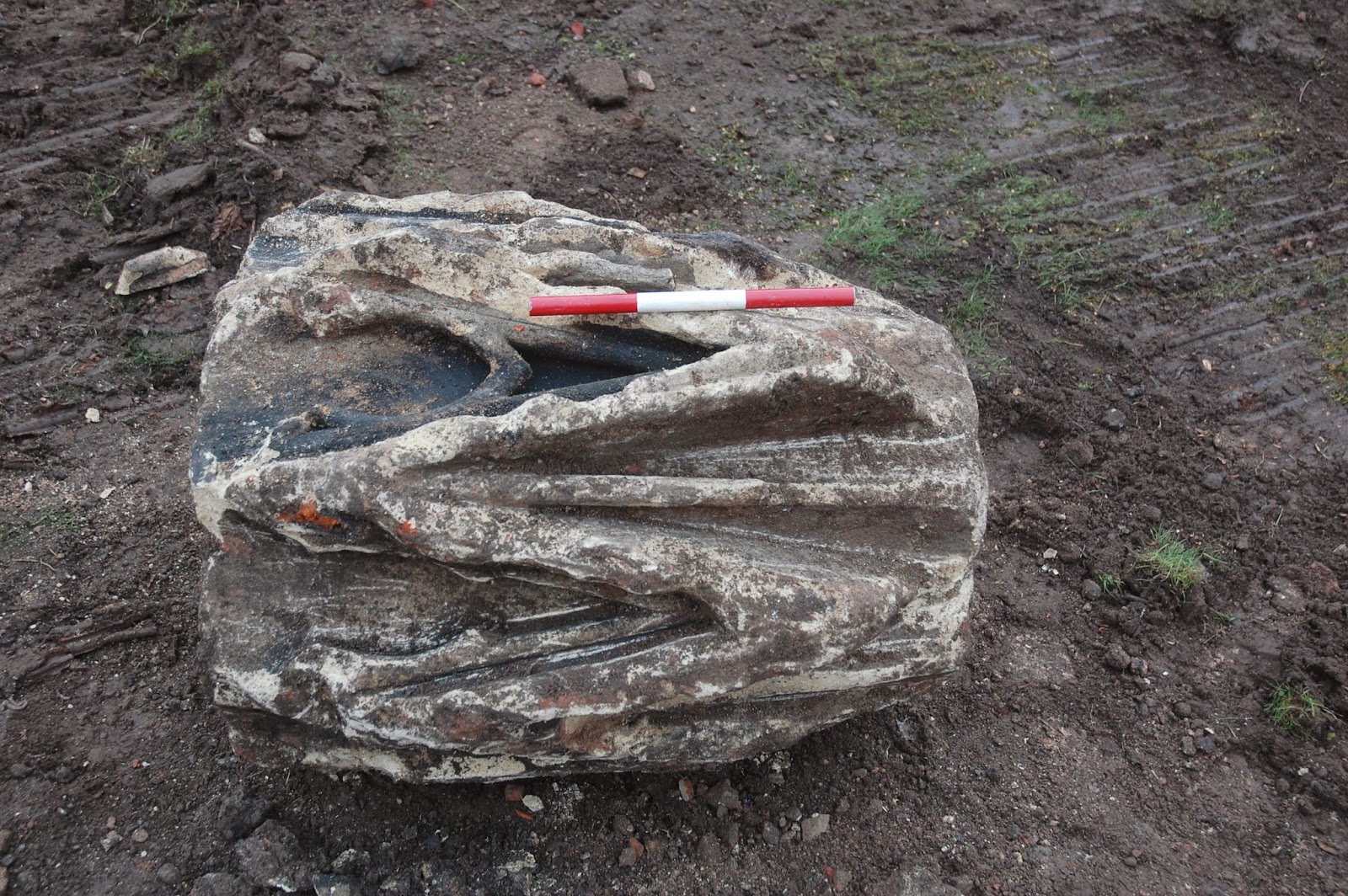
This amazing bit of masonry was discovered on site in backfill. It is well made so we wondered where it would have come from. Then an eagle eyed archaeologist thought they had seen it before and went back to have a look at one of the photos used in the preparation for the dig, and realised that it came from St Michael's, or is suspiciously similar. However the spot where it was uncovered was on the other side of the Lich St and a little way up, and this masonry had been on the College St side, so it had obviously travelled, after the church was demolished.


St Michael's was just to the south east of the excavation area under the road. This is the second St Michael's, the first having stood next to the cathedral. The main body of the church, which fronted College Street, lies under the road so we don't expect to uncover the church itself, although we have come up against an adjoining cellar wall.

This church replaced the medieval St Michael's in the 1840s. We have a poster from 1839 which invited people to donate towards the rebuilding, which is said was necessary due to the dilapidated state of the present church. The closeness to the cathedral is because it served as parish church to the immediate area and was the cemetery chapel, but it was decided to relocate the site in order to provide a better view of the Cathedral. We also have some specifications for the workmen involved in building the new church, such as carpenters, smiths and plasterers.


It was always a small parish as it only served the immediate vicinity of the cathedral, with other churches serving the rest of the city centre. In fact the northern side of the street was part of St Helen's. The 1851 Religious census, which compiled attendance figures from all places of worship, gave the population of the parish as 564, much smaller than the other city parishes, and attendance was under 100 for morning and evening services, much smaller than St Helen's and other nearby churches. A comment in the census stated that there was no Sunday School as there were only five or six poor families in the parish. The Church closed and became the Diocesan Registry in 1910, and was later demolished with the rest of Lich St in the 1960s. Some of the memorials went to St Helen's on the High Street, now part of All Saints parish.

Like many churches, St Michael's would have played an important part in the lives of the residents of Lich Street, not just on Sundays, but baptisms, marriages, burials, poor law administration, communal activities and charitable giving. The accounts of the St Michael's Charity are also in the archives, and it is noticeable that one of the trustees was Mr Arthur O. Mainwaring, who was also a grocer at No.1 & 3 (later renumbered 5) Lich St.


Parish records for St Michael's can be accessed through Worcestershire Archive & Archaeology Service in The Hive.

Friday, 17 April 2015

Out on the Tiles

For today's Friday Find we're looking at the roofs of medieval Worcester. Our county is rightly renowned for the beautiful thatched cottages that can be found in our rural villages. A well-thatched roof is an attractive, cosy and efficient cover, and thatchers' skills are in high demand once again as people rediscover the benefits of this ancient and sustainable craft.
However, in the crowded city streets of medieval Worcester, thatched roofs were a problem. Fire was a constant threat, and in the 12th century alone Worcester is recorded as having been burnt to the ground in 1113, 1131, 1139 and again in 1189!
In response to this problem, from the 13th century onwards we know that ceramic roof tiles were being made in the city: a tiled roof is much less flammable than a thatched one!
Medieval 'pegged' roof tile
The tile fragment above, discovered on the cathedral roundabout dig, was made in Worcester sometime between the 13th and 15th centuries. The tapering square hole would have held a peg to hook the tile over the laths of the roof.
It seems that flaming roofs remained a problem, because in 1467 the city ordinances introduced compulsory tiling, stating that
'for the prevention of fire neither wooden chimneys nor thatched roofs shall be allowed thenceforward; by midsummer's day next coming, the wooden chimneys should be replaced by brick or stone, and the thatched roofs by tiles'
Tilemakers were also required to stamp their wares with a maker's mark, and were forbidden from forming a union or guild. This is likely to have been an attempt to enforce quality standards and free trade, as the city feared that the new regulations would lead to a sellers' market.
Post-1467 rooftile stamped with maker's mark
The tile above was found recently in St Johns, and bears a maker's stamp in the form of a cross with flared arms, indicating it was made after the 1467 regulations were introduced.
We've excavated several Worcester kilns producing both roof and decorated floor tiles at around this date. The pictures below show the structure of a kiln on the Tything. There's an article by Laura Griffin with more information on this kiln in this issue of the Worcestershire Recorder, pages 5-8.
Late medieval tile kiln, The Tything, Worcester

Late medieval tile kiln, The Tything, Worcester

Friday, 10 April 2015

Personal connections

So far on our Friday Finds feature we've brought you pottery from 2000 years of Worcester's history, from local Roman wares and Worcester porcelain to exotic imports from abroad. Today's finds are a bit more personal, and connect us directly to the occupants of the street during the final years of its existence.
The first is a Military Police cap badge, recovered from an infilled cellar on the north side of Lich Street. It is in good condition for an object buried for over 50 years, although the slide bar at the back is damaged. The design gives us a date of 1936-46, so it is likely to have belonged to a soldier serving in the Corps of Military Police during the Second World War. We'd love to find out who it belonged to, so we're in the process of researching the names of the occupants of the street, and cross-referencing these with service records. If you have any information on friends or relatives who served as a 'Red Cap' and subsequently lived in or near Lich Street after the war, please get in touch with us!

Military Police cap badge
The second find is a beautifully hand-carved, delicate bone spoon. Bone spoons were often given as presents for occasions such as birthdays or christenings, but they had a practical purpose too: they were, and are still, used for foods where metal spoons can tarnish the flavour, such as soft-boiled eggs. This example seems to have been well-used: the handle has been polished to a very smooth sheen by frequent holding, whereas the neck and bowl remain slightly rough to the touch. You can almost imagine the owner's morning ritual: sitting down to breakfast, with a lovely soft-boiled egg, bone spoon in hand.
Hand-carved bone spoon
These finds are a personal, intimate connection to the lives of the occupants. They remind us that behind the walls and within the earth, archaeology is about connecting us with the traces of the lives of ordinary people. They may not have made it into the history books, but their lives, and their service, shaped the world we live in today.

Wednesday, 8 April 2015

Seeing the light of day

We'd like to share some great infrared photographs of the site taken by Peter Jenner using a full frame fisheye lens, showing the early stages of the excavation of the buried cellars and some of the finds recovered from them. We hope to feature more of Peter's photos as the dig progresses.
Bottles recovered from the infilled cellars
Yard surface and well to the rear of No 2, Lich Street
The mechanical excavator has now completed its work, and our archaeologists are out in the spring sunshine carefully 'cleaning' the exposed areas. 'Cleaning' in archaeology is the process of scraping back the loose top surface of material, usually with a small pointing trowel, to reveal the subtle differences in texture and colour that mark the boundaries between different deposits - much like sanding a piece of wood to reveal the grain.
'Cleaning' the site
Once an area is clean, we begin to examine each deposit to try and understand how its composition, how and when it formed and how it relates to other structures and deposits. Sometimes, like in the case of a rubble deposit that has been tipped into a cellar, this is simple, but often the boundary between a buried garden soil, a rubbish pit or an ancient foundation trench can be marked by nothing more than a subtle change in a shade of brown!
Filling out the records
Each different wall, floor, structure or deposit gets a unique reference number, and is photographed and recorded on a 'context sheet' and a scale plan. This record is vitally important, because in many cases it is the only chance that we have to understand the site before it is lost or reburied.
Hearth within cellar at the south-west corner of Lich Street and College Street
It is strange to think that many of these cellars are seeing the light of day for the first time: in most cases, they were excavated beneath existing buildings, and were infilled when those buildings were demolished around them, only to emerge into the spring sun hundreds of years later during these excavations.

Friday, 3 April 2015

Glimpses of Saxon Society

Not the most impressive-looking #FridayFinds this week, but one that has got our Finds Archaeologists very excited! The pictures below show a small piece of pottery, part of the rim of a storage jar with a 'diamond' pattern. It's a 'residual' find, meaning that it is a piece from earlier layers that has been brought close to the surface by disturbance of the ground, possibly during the construction of cellars along Lich Street. In colour and texture, it looks a bit like a burnt dog biscuit, yet this small piece is a window into a privileged part of a turbulent and uncertain world, over a thousand years ago.
Stafford-type ware: inside of the rim of a rouletted jar
This sort of pottery is called 'Stafford-type ware'; it was produced in Stafford, where more than 100,000 pieces have been found. Production started in the Anglo-Saxon period, at about 800 A.D., and continued to around the time of the Norman Conquest. This was a time in which the diverse and squabbling Anglo-Saxon kingdoms were frequently in conflict. Mercia's earlier dominance was eclipsed by Wessex, as the growing threat of Viking armies was eventually and narrowly quashed by King Alfred, before a unified England finally began to emerge in the 10th century.
Central to Alfred's winning strategy was the construction of 'burhs', fortified towns to which the local population could retreat, and from which a defence against the Vikings could be mounted. Worcester was one of these 'burhs', which also became important trading and production centres.
Outside of the rim and diamond pattern on shoulder
Stafford ware is usually found within these urban centres, often associated with high-status buildings or ecclesiastical centres, and seems to have been distributed mostly to places of elite or even royal interest. We know that a priory stood on the site of the Cathedral during this period, and the pottery may have come from there.

An example from Stafford
It isn't as finely-made as local Roman pottery, or as beautifully decorated as the medieval Worcester pottery that followed, but whatever it contained, the contents were highly-prized, and this little piece of pot tells us that Worcester was once at the heart of a struggle that went on to shape the country we know today.

Sunday, 29 March 2015

A view from above

This week, we've been up to the top of the Travelodge to get some photos of the work in progress.
Cathedral roundabout from the northeast
Lich Street itself can be seen running from the centre right to the bottom left of the picture. Either side, you can see the foundations of the buildings that once lined the street, many of which had deep cellars.

Lich Street revealed
In the foregound at the bottom of the picture, you can see the remains of a yard surface and circular well. The yards served the rear of the properties along the north edge of Lich Street and the south end of the High Street. The well would have been the only source of fresh water for many of the surrounding buildings. A small 'P' on the 1886 Ordnance Survey map marks the existence of a pump to draw water from the well.

Friday, 27 March 2015

A tale of two pots

People often think that archaeology is all about finding artefacts - precious things, rare things, old things. It's not - it's about people. How they lived, where they lived, what their concerns, hopes and fears might have been, and how those people shaped the landscape in ways that still influence our settlements and behaviour today.
But often, the window into those lives lived long ago is through the artefacts they left behind. And today's post is a tale of two pots: one local, one international, that tell us about economy, industry and trade in Worcester hundreds of years ago.
The first piece of pottery is a tiny fragment of a vase made 400 miles away, in the South Netherlands. It's a piece of 'South Netherlands Tin-glazed Maiolica', one of a group of wares commonly called 'Delft ware'. It was made in the 16th or early 17th century, as Worcester was thriving on the profits of the cloth trade, and before the turmoil of the Civil War. The picture on the right shows what the complete vessel would have looked like, based on an example found in Exeter. These imports are rarely found in Worcester. They would have been treasured possessions, and show that over 400 years ago, trade links to the continent were far-reaching.
South Netherlands Tin-glazed Maiolica, 16th/early 17th century
The second piece has travelled less than 400 metres from its place of manufacture, and is evidence of the success of home-grown industry and innovation. In 1751, the Worcester Porcelain Company began production at a factory on the site of the Copenhagen Street car park. The company quickly gained a reputation for producing the finest English porcelain available, and were a fixture of Worcester industry for over 250 years.
The example below is unusual: haphazard splodges of red, black and gold are smeared across both faces. We think it was probably a 'test piece', to check the colour of the glaze after firing or to test a new decoration technique. It may then have been either discarded or sold cheaply as a 'second'.
Worcester Porcelain 'test piece'
These two pots, one local and one international, take us back to the processes of trade and industry that laid the foundations for the city we know today, and ultimately to the people who made, imported, bought and enjoyed them.

Tuesday, 24 March 2015

Dig Lich Street

Welcome to the Dig Lich Street blog, which will provide information on progress, events and opportunities to find out more during the archaeological work on Worcester's Cathedral Plaza roundabout.
Worcestershire Archive and Archaeology Service are conducting the excavations, which are the first investigation works to support the Worcester Cathedral square improvement scheme.
Removing the topsoil using a mechanical excavator

Work began on the site earlier this month, with a mechanical excavator removing the topsoil down to the level of the archaeological remains preserved beneath the roundabout, under the watchful eye of Project Officer Richard Bradley. Our archaeologists are now in the process of clearing material away by hand to reveal the footings of the buildings that once fronted Lich Street, whilst the excavator continues to remove the remaining topsoil. Once the machinery is off-site and the archaeology has been fully exposed, there'll be chances for members of the public to take a closer look
The redevelopment work will only affect the upper levels of the archaeological deposits, but we've encountered a number of cellars, which need to be excavated fully as they contain loose, unstable rubble deposits. Most of the rubble is removed using the excavator, before final careful cleaning by hand.
Removing rubble from an infilled cellar.
Already, the finds are giving us glimpses into the earlier history of the site. One of the most common and informative types of artefact found on archaeological sites is pottery: hard-fired ceramics can survive in the ground for thousands of years, and tell us much about the fashions, technology, trade and economy of Worcester in the past.
The two examples below span 1000 years of Worcester's history. On the left is a piece of the rim of a 2nd-4th century A.D. Roman Severn Valley Ware storage jar, probably made locally: we know that there was a kiln nearby. The distorted shape and patches of grey colouration are due to mis-firing, so it's likely that this was either a 'waster', discarded from the nearby kiln, or possibly used as a 'second'. The brightly-glazed piece on the right is from a 13th-14th century Malvernian medieval jug, probably manufactured in the kilns at Hanley Swan in South Worcestershire.
Early finds from the excavation: Roman (left) and medieval (right) pottery
There'll be regular updates, and news of opportunities to find out more, on this blog. You can also follow us on Twitter and Facebook. There'll be opportunities to share memories of the area at drop-in sessions, and via the online form.
Got any questions? We'll be adding Frequently Asked Questions to this page as the project progresses. You can also contact us directly.